
Temperature Cycling Testing: Coffin-Manson Equation
Temperature Cycling Testing: Coffin-Manson Equation
Temperature cycling testing is another method of accelerated life testing for products that are exposed to temperature variations during use in normal operation. The temperature variations can be a result of self heating for products that are repeatedly turned on and off, or can be the result of cyclic environmental changes — such as temperature variations from day to night — or other causes.
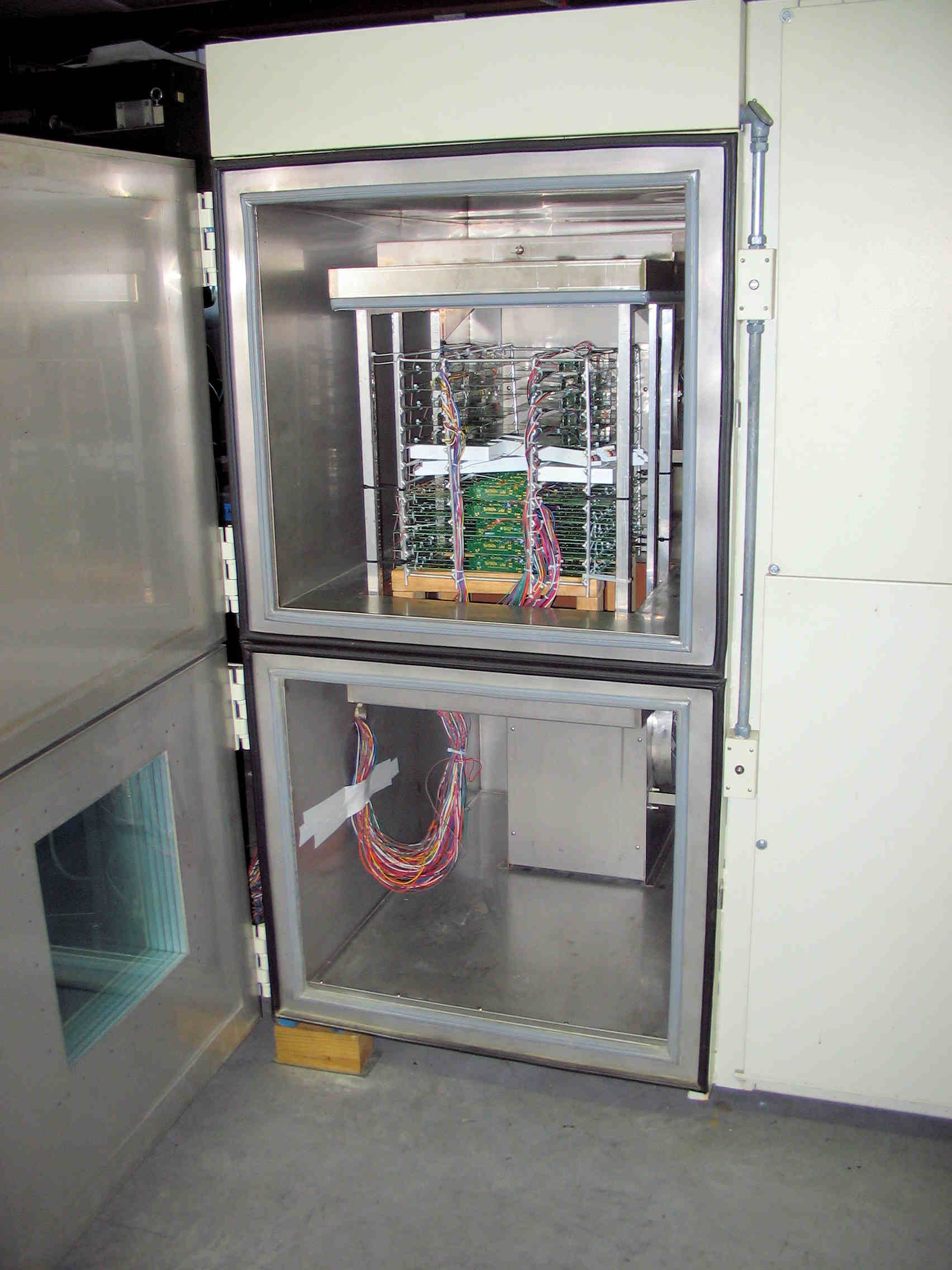 These repeated temperature changes can result in thermal fatigue and lead to eventual failure after many thermal cycles. Accelerated life testing can be performed by cycling the product to high and low temperatures that exceed its normal use temperatures.
It should be noted that temperature cycling may also be referred to as thermal cycling or thermal shock testing. However, some test standards, such as MIL-STD-883, make the distinction between temperature cycling being performed as air to air testing and thermal shock being performed with the samples transferred between liquids. This article deals with testing performed using an air to air thermal cycle chamber.
Typical temperature cycling equipment consists of at least one hot chamber and one cold chamber. The test samples are automatically transferred between the two chambers by an elevator-type mechanism. It is also possible to perform temperature cycling in a single compartment chamber where the temperature is ramped between hot and cold. This generally produces a slower rate of temperature change compared to the two chamber method.
The acceleration factor resulting from the temperature cycle test is the ratio of the product life at normal operating conditions to the life at accelerated test conditions and is given by the Coffin-Manson equation:
AF = (ΔT test / ΔT use) m
AF = Acceleration Factor
ΔT test = Test temperature difference (°C)
ΔT use = Use temperature difference (°C)
m = Fatigue or Coffin-Manson exponent
As an example, assume a product that undergoes 5 daily temperature transitions from
20 °C to 60 °C (ΔT use = 40 °C) while it is normally being used. The following acceleration will occur if the product is temperature cycle tested using a high temperature of 100 °C and a low temperature of -20 °C (ΔT test = 120 °C), assuming a typical Coffin-Manson exponent of 3:
AF = (120 / 40)3 =27
Testing this product for 1000 temperature cycles using the accelerated conditions would therefore be equal to 15 years of life based on the stated use conditions.
(27 X 1000 cycles) / ((5 cycles per day) (365 days per year)) = 14.8 years
However, care must be taken when choosing the test conditions so that both the upper and lower temperatures used do not exceed the temperature limits of the product. Doing so can result in failure modes that would not occur during normal operating conditions.
The rate of change between the cold and hot temperatures should also be controlled. Some specifications require that the test specimen reaches the dwell temperature within a given time limit for each change in temperature.
The proper dwell time at temperature extreme must also be considered. In general, the time must be long enough to allow the part to equilibrate to the air temperature. Larger and heavier parts with a higher thermal mass will therefore need longer dwell times than lighter and smaller parts with less thermal mass.
It is also important not to remain at the dwell temperatures for too long of a time, as this can also result in invalid failure modes. An example of this would be solder creep failure in a circuit board that is soaked for too long of a time at a temperature too close to the melting point of the solder.
Knowing the correct value for the fatigue or Coffin-Manson exponent is also important, as small changes in this exponent can have larger changes in the acceleration factor. Exponents for many materials have been reported, and can be found in the literature or on the Internet. It is also possible to experimentally determine the fatigue exponent by performing multiple tests with different values of ΔT test.
Delserro Engineering Solutions, Inc. (DES) has many years of experience performing temperature cycle testing and can assist customers in setting up a test using the proper test conditions and correlating the results to time in the field.
So if you don’t know what test conditions you should use, what specification to choose, or how to correlate your test to field life, we can help you, because we are reliability testing experts!